
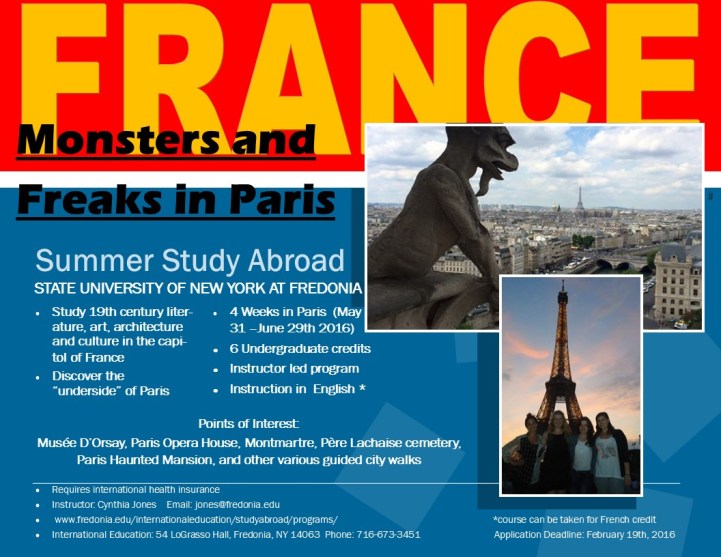
France during the nineteenth century was undergoing many changes, including the aftermath of the French Revolution and the tumultuous shift from agrarian society to urban during the Industrial Revolution. The sudden rise in urbanization and progress brought with it anxieties and notions of moral decline which ushered in the decadent movement in literature. Decadence became a reaction to progress and expressed itself via embracing the monstrous and the supernatural in order to explore the darker side of humanity. Figures such as the Dandy and the Flâneur paraded the streets of Paris, both accepted and rejected within society. Monsters such as the werewolf, the vampire and freaks –usually those found in circus freak shows— made their appearance in literature, both exploring the depths of the human soul and exposing a corrupted a society. In this class, literary works from Victor Hugo, Alexandre Dumas, Charles Baudelaire, J-K Huysmans, Rachilde, Guy de Maupassant, Emile Zola, and Gaston Leroux will be selected and discussed alongside theory on monstrosity, masculinity, freaks and freakery, as well as disability studies in order to gain a deeper insight into the literature from this time period, and how it possibly applies (and in what ways) to the twenty-first century.
Points of interest include: a tour of the famous Paris Opera house, Notre Dame Cathedral, Victor Hugo’s house, Montmartre, the Musée D’Orsay and the Gustave Moreau Museum. The course will be conducted in Paris, where students will have lectures, and tours related to class discussion during the day, leaving ample time for general sightseeing in the late afternoon, evenings and weekends.
The aim of this course is to increase the students understanding of France’s –and more specifically –Paris’ literary past and how the city, with its different neighborhoods, and monuments are reflected, embellished and mythologized in French nineteenth century literature.
Knowledge of French is not a requirement for the course. Lectures and tours will be given in English, and students may complete the required readings, journal and final paper in English. However, students will be able to take this course for French credit by reading the required texts in French, keeping a journal in the target language and doing the final paper in French.
 Cynthia Jones, PhD
You must be logged in to post a comment.